More Than a Place to Park: The Outsized Role of Driveway and Garage Configuration in Scarsdale Home Values
Few features of a residential property are as easy to overlook during an initial showing as the driveway. Buyers touring a well-appointed Colonial or a recently renovated Tudor tend to focus on kitchen finishes, ceiling heights, and the condition of the primary suite. The garage, if it is considered at all, is typically assessed in a matter of seconds. Yet in Scarsdale—where households routinely maintain two or more vehicles, where municipal street parking restrictions are meaningfully enforced, and where winters can complicate outdoor storage for months at a stretch—the configuration of a property's parking infrastructure carries financial consequences that compound quietly over years of ownership.
Understanding why requires examining not just the garage itself, but the broader ecosystem of vehicular logistics that shapes daily life in the neighborhood.
The Parking Reality of Suburban Westchester
Scarsdale is not a community designed around the assumption that residents will leave their cars elsewhere. Its residential streets, while generally well-maintained, are not built to absorb overflow parking from households that have outgrown their off-street capacity. Many blocks are governed by overnight parking restrictions that make the street an unreliable backup option. For families with teenage drivers, home-based contractors, or simply the accumulation of vehicles that tends to accompany suburban life over time, the finite geometry of a driveway is not an abstraction—it is a daily operational constraint.
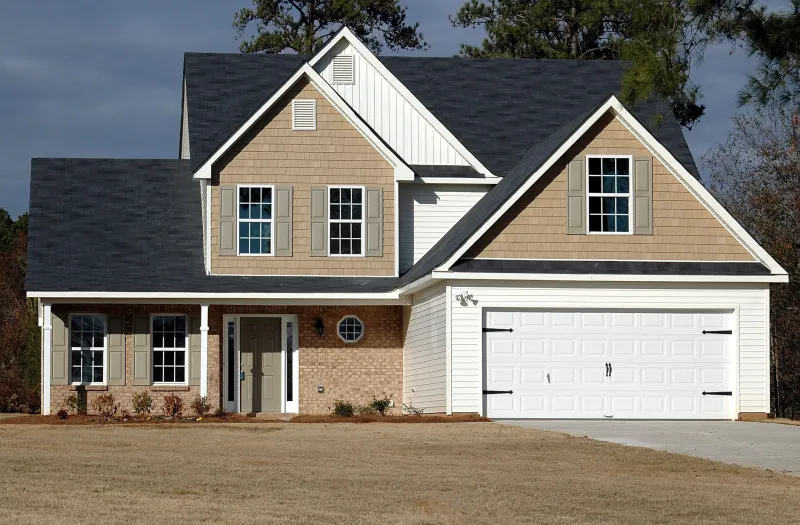
This reality is reflected in how buyers behave at the point of purchase. A property offering a two-car attached garage with a wide apron—room enough to accommodate additional vehicles in the driveway without blocking the sidewalk or encroaching on neighboring sightlines—commands a measurable premium over an otherwise comparable home with a single-car garage or a detached structure set awkwardly at the rear of the lot. The premium is rarely itemized in listing materials, but experienced local agents will confirm that it surfaces reliably in offer prices and negotiation outcomes.
Why Configuration Matters as Much as Capacity
It is insufficient to count garage bays in isolation. The manner in which a garage relates to the house, the street, and the driveway approach shapes its practical utility in ways that raw square footage cannot capture.
A two-car garage accessed through a long, straight driveway is meaningfully different from one that requires a sharp turn to enter, particularly during winter months when ice can render tight maneuvers hazardous. A tandem configuration—where one vehicle must be moved to access the other—functions less like a two-car garage in daily practice and more like a storage unit with a bonus parking space. Side-entry garages, which are common in certain architectural styles prevalent in Scarsdale's older neighborhoods, can add curb appeal while introducing their own logistical trade-offs depending on lot width.
Buyers who think carefully about these distinctions—rather than simply noting that a listing advertises "two-car garage"—are better positioned to assess genuine utility and, by extension, genuine value.
The Resale Dimension
Property values in Scarsdale are sustained, in part, by the community's consistent appeal to families at a specific life stage: typically those with school-age children, established careers, and a household composition that generates real parking demand. This demographic profile does not change significantly from one decade to the next, which means that the features valued by today's buyers will, with high probability, be valued by the buyers to whom today's purchasers eventually sell.
A home with a well-configured two-car garage and a generous driveway is not merely convenient for its current occupants. It is, in a meaningful sense, pre-qualified for the next transaction. Conversely, a property that requires creative parking solutions—relying on a detached single-car structure, a narrow approach, or a gravel pad that was added as an afterthought—may find its buyer pool narrowed at the moment of resale, particularly if competing listings offer more straightforward vehicular arrangements.
This asymmetry between parking-adequate and parking-constrained properties tends to widen during periods of high inventory, when buyers have the luxury of being selective. In tighter markets, the gap compresses, but it rarely disappears entirely.
The EV Charging Variable
An emerging consideration that has begun to influence buyer preferences in Scarsdale—as in much of upper Westchester—is the capacity of a garage to accommodate electric vehicle charging infrastructure. A detached garage located at a significant distance from the main electrical panel, or a structure without the amperage to support a Level 2 charger, represents a friction point for the growing share of buyers who either drive electric vehicles or anticipate doing so within the foreseeable future.
This is not yet a decisive factor in most transactions, but it is increasingly a question that surfaces during due diligence. Properties with attached garages, direct panel access, and sufficient electrical capacity are better positioned to accommodate this shift without requiring buyers to absorb upgrade costs as part of their purchase calculus.
A Framework for Evaluation
For prospective buyers evaluating a Scarsdale property, the following questions offer a practical starting point for assessing parking infrastructure:
- How many vehicles does the household currently operate, and how many are anticipated within a five-year horizon?
- Can the driveway accommodate a visiting vehicle without requiring one of the household's own vehicles to be relocated?
- Is the garage attached or detached, and how does that configuration affect both daily convenience and electrical upgrade feasibility?
- Are there any municipal restrictions—setback requirements, impervious surface limits—that would preclude expanding the driveway or adding a parking pad if needed?
None of these questions is glamorous. None of them will appear in the marketing copy for a listing. But the answers, taken together, can meaningfully differentiate between two properties that appear equivalent on paper and produce divergent outcomes over a decade of ownership.
In Scarsdale, as in most communities where daily automobile use remains a structural fact of life, the unglamorous infrastructure of parking is not incidental to property value. It is embedded within it.