The Full Ledger: Counting Every Dollar the Suburban Savings Argument Leaves Out

The pitch arrives in some variation of the same sentence: You can get so much more for your money outside the city. It is delivered by real estate agents, by friends who made the move two years ahead of you, by financial content on the internet that compares Manhattan one-bedroom rents to Westchester square footage and presents the arithmetic as self-evident. The suburbs, in this framing, are a savings engine. The math is simple. The conclusion is foregone.
It is also incomplete.
The full cost of suburban living is not captured in the rent or mortgage line. It is distributed across a constellation of expenses that rarely appear in the same calculation — and that, when aggregated, can substantially erode the apparent savings that motivated the move in the first place. For households evaluating a transition to a Scarsdale address, understanding this full ledger is not pessimism. It is due diligence.
The Car Problem
In Manhattan, car ownership is optional. For most residents, it is actively irrational — a monthly expense for insurance, garage storage, and registration that delivers little practical value in a borough served by dense transit infrastructure.
In Scarsdale, car ownership is not optional. It is, for most households, a prerequisite. And in most families making the suburban transition, one car is rarely sufficient. Two-income households with school-age children frequently operate two vehicles, each carrying its own cost structure.
The American Automobile Association's annual Your Driving Costs study provides a useful baseline. Depending on vehicle type and annual mileage, the all-in cost of owning and operating a single car — depreciation, fuel, insurance, maintenance, registration, and financing — ranges from approximately $8,000 to $12,000 per year. For a two-car household, that figure doubles. This is money that, in a Manhattan household, would simply not be spent.
The comparison is not perfectly clean. Some Manhattan residents do own vehicles. Some suburban households manage with one car. But the directional point holds: the automotive cost of suburban life is a meaningful line item that the rent-versus-mortgage comparison almost never includes.
Time as a Financial Variable
The Metro-North commute from Scarsdale to Grand Central Terminal runs approximately 35 minutes under favorable conditions. That is, by any measure, a reasonable transit time — and one of the genuine advantages of a Scarsdale address relative to more distant Westchester communities.
But the commute is not 35 minutes. It is the walk or drive to the station, the wait on the platform, the ride, the walk or subway transfer at Grand Central, and the arrival at the final destination. Door-to-door, a realistic estimate for many Scarsdale-to-Midtown commuters is 60 to 75 minutes each way. For a five-day workweek, that is 10 to 12.5 hours of transit time. Annualized over 48 working weeks, the figure approaches 500 to 600 hours per year.
Time has an economic value. For a professional earning $150,000 annually, a rough hourly rate exceeds $70. Applying that rate to 500 hours of annual commuting yields an implicit cost of $35,000 or more — not in cash expenditures, but in foregone productive or restorative time. This figure does not appear on any housing cost comparison. It is nonetheless real.
The Maintenance Burden of Single-Family Living
Condominium and apartment living insulates residents from a category of costs that single-family homeowners absorb in full: structural maintenance, roof replacement, HVAC servicing, landscaping, snow removal, and the innumerable smaller repairs that older housing stock demands.
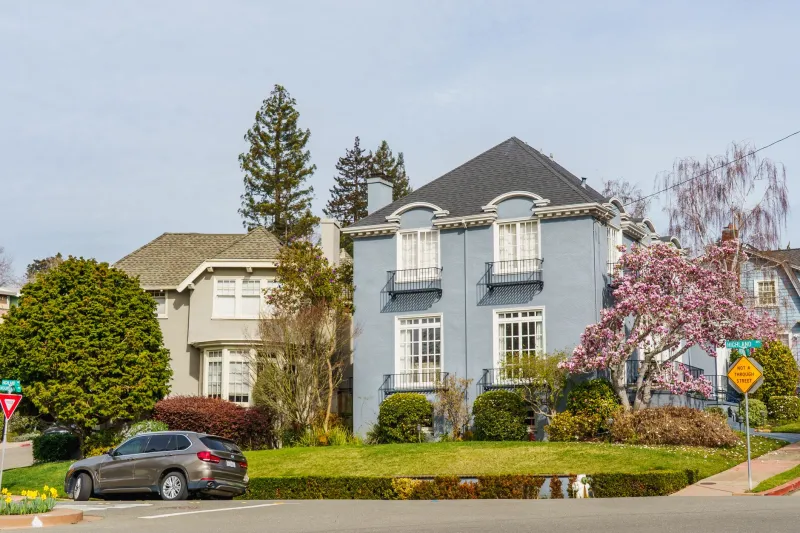
Scarsdale's residential inventory skews toward homes built between the 1920s and the 1970s. These are architecturally distinguished properties, but they are also properties that carry the maintenance obligations of age. A furnace replacement, a roof resurfacing, a foundation repair — each of these events can run from several thousand to tens of thousands of dollars. Unlike rent, these costs are irregular and difficult to budget. They arrive without notice and cannot be deferred indefinitely.
Homeowners who track their maintenance expenditures carefully over a decade frequently discover that annual costs equivalent to one to two percent of home value — a figure commonly cited by financial planners — understates what older suburban homes actually demand. At Scarsdale price points, even the conservative estimate represents a significant annual outlay.
Opportunity Cost and the Equity Question
The down payment required to purchase a Scarsdale property is not a small figure. At current price levels, a twenty percent down payment on a median-priced home represents a capital commitment that, if deployed differently — in a diversified investment portfolio, for instance — would generate its own return stream.
This is the opportunity cost of homeownership, and it is one of the least-discussed elements of the buy-versus-rent calculation. The equity tied up in a home is not idle — it does appreciate, in Scarsdale's case with reasonable consistency — but it is also illiquid, concentrated in a single asset class, and subject to transaction costs of six to ten percent when it is eventually realized.
For households who are genuinely comparing suburban homeownership to continued urban renting, incorporating the opportunity cost of the down payment into the model changes the arithmetic in ways that are not always favorable to the purchase.
What the Comparison Should Actually Look Like
None of this is an argument against Scarsdale, or against suburban living more broadly. The quality of life, the school district, the community fabric, and the space that a Scarsdale address provides are genuine values that do not reduce to a spreadsheet line. For many households, those values are worth the full cost.
The argument, rather, is against the incomplete comparison. The household that moves to Scarsdale believing it has unlocked a straightforward financial improvement — simply by trading a Manhattan rent for a lower mortgage payment — is working from a partial model. The full ledger includes cars, commuting time, maintenance obligations, and opportunity costs. When those figures are incorporated honestly, the savings may be smaller than anticipated, or structured differently than expected.
For residents of 105 Garth Road, the condominium model offers one way to compress several of these cost categories. Maintenance obligations shift to the building, the car-dependence question is mediated by walkable proximity to the Scarsdale train station, and the carrying cost structure is more predictable than a single-family home of comparable vintage. The comparison still deserves rigor. But the inputs, at least, are more transparent.