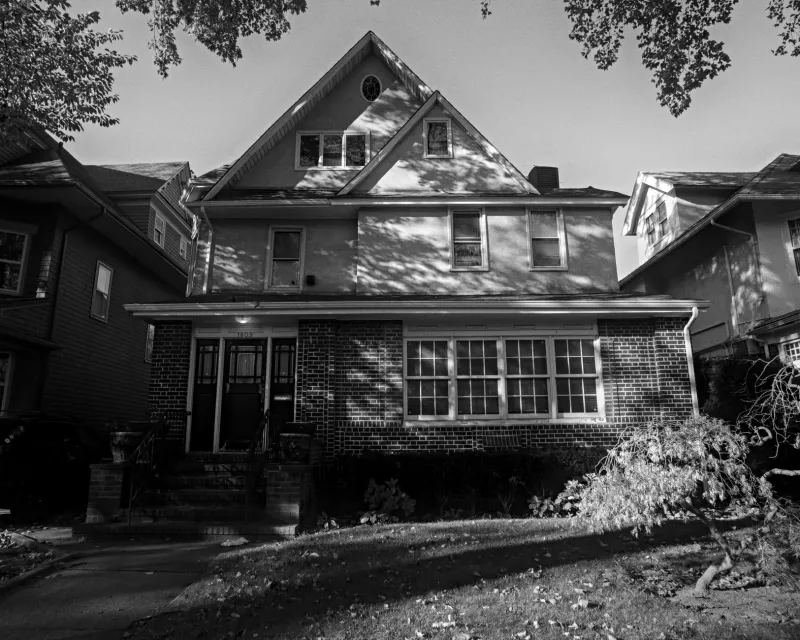
Off the Algorithm: How Scarsdale's Market Opacity Quietly Rewards the Patient Owner-Occupant

There is a particular kind of irony embedded in modern real estate markets. The more aggressively institutional investors and algorithmic pricing platforms pursue a neighborhood, the more efficiently — and expensively — that neighborhood becomes priced. Efficiency, in this context, is not a gift to the buyer. It is a ceiling on future appreciation, a compression of the spread between what a property is worth and what you pay for it. When Wall Street finds a zip code, the easy gains tend to disappear.
Scarsdale, and specifically the kind of mid-sized residential address represented by 105 Garth Road, has largely escaped this fate. Not by accident, and not simply because it lacks appeal — but because it possesses qualities that institutional capital is structurally incapable of valuing correctly.
What Algorithmic Models Are Built to See
To understand the opportunity, it helps to understand the limitation. Institutional real estate investors — whether large iBuyers, single-family rental aggregators, or private equity funds targeting residential portfolios — rely on models that excel at processing standardized data at scale. Transaction volume, median price per square foot, cap rates, rental yield projections, days on market: these are the inputs that drive acquisition decisions.
What these models cannot easily quantify is the texture of a community. The particular draw of a walkable village center. The social infrastructure that forms among neighbors who stay for decades. The reputational weight of a school district that requires no explanation to any employer in the New York metropolitan area. The way a 25-minute train ride to Grand Central functions not merely as a commute but as a daily boundary between professional obligation and residential calm.
These are not soft considerations. They are, in fact, the primary drivers of long-term value in addresses like 105 Garth Road. But because they resist clean quantification, they tend to be underweighted — or missed entirely — by systems optimized for speed and scale.
The Inefficiency That Benefits You
Market inefficiency carries a negative connotation in most financial discussions. In real estate, however, inefficiency in a market you are entering is precisely what creates the conditions for outperformance. When a property is priced below its genuine long-term utility — because the instruments measuring that utility are blunt — the owner-occupant who recognizes the gap stands to capture returns that no model predicted.
Scarsdale's residential market has historically exhibited this quality. Transaction volumes are modest relative to more transient urban markets. Turnover is low, a reflection of owners who tend to stay rather than cycle through. The absence of a large rental inventory further suppresses the kind of data density that attracts algorithmic attention. From an institutional standpoint, the market is simply too thin, too idiosyncratic, and too relationship-driven to be worth the infrastructure cost of systematic targeting.
For the individual buyer, this is a structural advantage. You are not competing against entities with lower costs of capital and faster decision-making pipelines. You are competing against other owner-occupants, most of whom are similarly constrained by the same human-scale considerations that make the neighborhood valuable in the first place.
Why Cooperative-Style Living Compounds the Effect
Addresses like 105 Garth Road introduce an additional layer of institutional indifference. Cooperative and condominium structures with owner-occupancy requirements, board approval processes, and restrictions on subletting are, by design, inhospitable to investors seeking rental yield or quick resale. This is sometimes framed as a limitation. It is more accurately understood as a filter.
That filter removes a class of buyers whose presence tends to destabilize markets. It concentrates ownership among residents with genuine long-term stakes in the building's condition, community character, and governance. Over time, this concentration produces a more stable, well-maintained asset — one whose value accrues steadily rather than spiking and correcting in response to investor sentiment cycles.
The irony is that the very features making a property unattractive to institutional capital — illiquidity, governance requirements, low transaction frequency — are among the most reliable predictors of durable value for the patient owner-occupant.
What the Data Doesn't Capture About This Address
Consider what a pricing model would register when evaluating a unit at 105 Garth Road. Square footage, bedroom count, proximity to transit, recent comparable sales: these inputs produce a number. What they cannot produce is an account of what it means to live within walking distance of Scarsdale Village, to have Metro-North's Harlem Line accessible without a car, to reside in a school district whose academic outcomes are not a marketing claim but a decades-long institutional reality.
They cannot capture the compounding effect of stability — the way a fixed housing cost in a building with measured, predictable expenses insulates a household from the rent volatility that has defined New York City's residential market for the better part of two decades. They cannot model the social capital that accumulates in a building where neighbors recognize each other, where tenure is measured in years rather than months.
These are the variables that determine whether a home functions as a genuine long-term asset or merely a line item on a balance sheet. And they are precisely the variables that remain invisible to the systems most aggressively reshaping real estate markets elsewhere in the tristate area.
The Strategic Case for Staying Overlooked
There is a reasonable argument that Scarsdale's continued invisibility to institutional capital is not a condition to be corrected but a feature to be preserved. The neighborhoods that have attracted the most aggressive investor attention over the past decade — certain Brooklyn submarkets, parts of Jersey City, stretches of Long Island City — have seen appreciation compress alongside displacement, character erosion, and the gradual replacement of community with inventory.
Scarsdale has not followed this trajectory. Its market remains, by most measures, a domain of owner-occupants making long-horizon decisions. That is not a limitation of the market's sophistication. It is a reflection of what the market is actually for.
For the household evaluating 105 Garth Road as a primary residence, this context matters. The decision to purchase here is not a bet on algorithmic discovery or institutional validation. It is a recognition that certain forms of value — community, stability, proximity to genuine urban access without the costs of urban density — are best captured by those who intend to inhabit them rather than to trade them.
The paradox, then, resolves simply: the address that Wall Street cannot see clearly is often the one most worth owning.