Leaving Manhattan Without Leaving Behind: The Surprising Truth About Suburban Transitions
There is a particular kind of social calculus that governs conversations among Manhattan professionals. It concerns addresses, neighborhoods, proximity to certain restaurants, and the unspoken hierarchy of zip codes. Within this framework, leaving the city — for any reason, under any circumstances — tends to be narrated as a concession. A stepping back. The suburbs, in this telling, are where ambition cools and convenience evaporates.
And yet, something curious happens when you speak with people who have actually made the move. Particularly those who have settled in Scarsdale, and more specifically, in residences like 105 Garth Road. The word they reach for, almost invariably, is not "compromise." It is "upgrade."
The Prestige Trap and What Lies Beyond It
Part of what makes this transition so psychologically complex is the weight of identity that Manhattan living carries. For a certain demographic — finance professionals, attorneys, physicians, executives — a New York City address is not merely a geographic fact. It is a credential. It signals proximity to power, cultural fluency, and a particular kind of ambition made visible.
Abandoning that credential, even voluntarily, can feel like a form of social demotion. This is the prestige trap: the conflation of a city address with a city life well lived.
What many transplants discover, sometimes within weeks of settling into Scarsdale, is that the credential was doing far less work than they imagined. The things they valued most — intellectual stimulation, proximity to accomplished peers, access to culture and cuisine, a sense of being embedded in a community with high standards — did not vanish when they crossed the Westchester County line. In many cases, they intensified.
Space as a Psychological Variable
One of the most immediate and underappreciated dimensions of this transition is spatial. Manhattan apartments, even generously proportioned ones, impose a particular discipline on daily life. Furniture must multitask. Storage is a constant negotiation. The boundary between work and rest, between public and private, is often measured in feet rather than rooms.
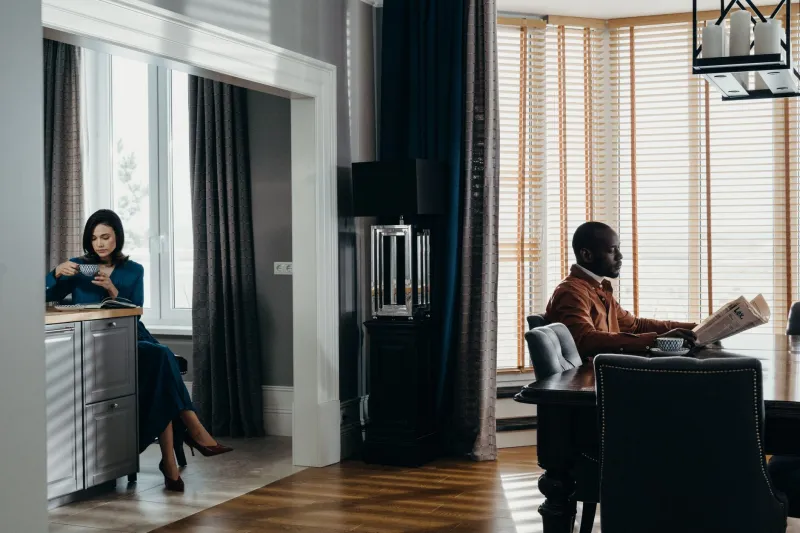
Moving into a unit at 105 Garth Road introduces a different spatial grammar. There is room for a proper dining table, for a home office that closes its door at the end of the workday, for a guest room that doesn't require a sofa bed and an apology. These are not trivial luxuries. Research in environmental psychology has consistently linked spatial autonomy — the ability to move through one's home without constant compromise — to lower stress levels, better sleep, and improved cognitive performance.
For professionals accustomed to treating their apartment as a launching pad rather than a dwelling, the experience of actually inhabiting a home can be quietly revelatory.
What the Commute Gives Back
Skeptics of the suburban transition often point to the commute as the decisive argument against it. And it is true that trading a ten-minute subway ride for a thirty-five-minute Metro-North journey represents a shift in routine. But the nature of that shift is worth examining carefully.
The Metro-North ride from Scarsdale to Grand Central is not the same experience as a Manhattan subway commute. It is seated. It is quiet — or at least quieter. It permits reading, thinking, writing, and the kind of sustained attention that a crowded underground train rarely allows. Several residents of 105 Garth Road have described the commute not as lost time, but as recovered time: a daily interval of structured solitude that the city, for all its virtues, could not reliably provide.
There is also the matter of what awaits at the end of the return journey. Arriving home to a neighborhood where one can walk, breathe, and decompress — rather than navigating another layer of urban density — changes the emotional texture of the evening in ways that are difficult to quantify but easy to feel.
Community as a Competitive Advantage
One of the persistent myths about suburban living is that it represents a retreat from community into isolation. The reality in Scarsdale challenges this assumption at nearly every level.
The social fabric here is dense, engaged, and — perhaps surprisingly to those arriving from the city — intellectually demanding. Scarsdale's population skews toward the highly educated and professionally accomplished. The conversations at local gatherings, school events, and neighborhood associations reflect this. The sense of anonymity that Manhattan can confer — being one of eight million, known to few and accountable to fewer — gives way to something more legible: a community where relationships are sustained over years rather than refreshed by constant turnover.
For families with children, this distinction carries particular weight. The schools, the extracurricular infrastructure, the simple fact of knowing one's neighbors by name — these elements compose a social environment that the city, for all its richness, rarely replicates at the neighborhood level.
105 Garth Road as a Case Study in the Transition
What makes 105 Garth Road a particularly instructive example of this broader phenomenon is the way it bridges rather than breaks from urban sensibility. The building's location places residents within easy reach of Scarsdale Village — its shops, its restaurants, its train station — without requiring a car for every errand. The architectural character of the address maintains a certain formality and permanence that resonates with those accustomed to pre-war Manhattan buildings.
In practical terms, residents retain much of what they valued about city living — walkability, density of amenity, proximity to transit — while gaining what the city could not offer: space, quiet, and a pace of life calibrated to something other than urgency.
This is the counterintuitive logic at the heart of the Scarsdale transition. It is not a subtraction. It is, for many who make it thoughtfully, an arithmetic of addition.
Rewriting the Narrative
The professionals who have settled at 105 Garth Road and in Scarsdale more broadly are not, by and large, people who have stopped caring about quality. They are people who have refined their definition of it.
They have recognized that quality of life and quality of address are not synonymous. That prestige is a useful signal but a poor substitute for actual wellbeing. That the square footage of one's commute, the depth of one's community ties, and the volume of one's home at the end of the day are not secondary concerns — they are, in fact, the primary ones.
Leaving Manhattan, in this light, is not a retreat from ambition. It is an expression of it: the ambition to live deliberately, to invest in place as well as career, and to resist the narrative that equates proximity to the city's center with proximity to a life well constructed.
For those standing at that particular crossroads, 105 Garth Road offers something rarer than a competitive price per square foot. It offers a genuinely different answer to the question of what a good life, practically arranged, might look like.